How can a low-carbon fit-out help a client deliver on multiple fronts?
How can a low-carbon fit-out help a client deliver on multiple fronts?
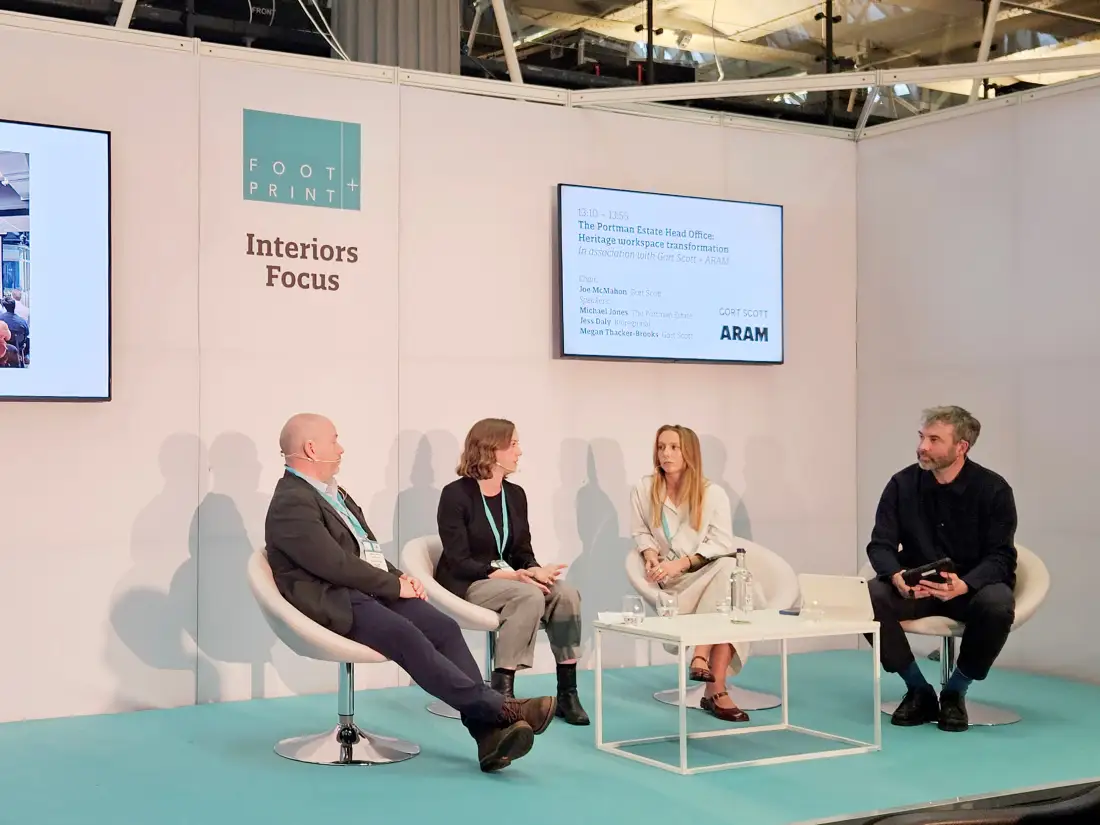
We discussed this at last month’s Footprint+ with Michael Jones, Projects Director at The Portman Estate, and Jess Daly of Bioregional.
Fit-outs have historically been short-lived and carbon-intensive. The Portman Estate wanted a head office that would embody their One Planet Living framework, test new materials, and demonstrate new approaches to staff and the wider supply chain.
Embodied carbon was a priority and was reduced in three ways:
1. Building less
• Creating only what is needed to provide secure, acoustically varied work environments, with flexibility built in.
• Working with the existing building rather than against it by retaining 85%+ of the shell and core, and allowing its character and outlook to shape the design.
2. Building right
• Intensive early engagement and analysis led to a layout that reflects how the organisation actually works and gives what they actually need: With this insight, rooms could be omitted, resized or made multi-functional, in confidence that they would outlast the typical replacement cycle.
• Full-size mock-ups, made from materials later re-used on site, gave reassurance that these spatial decisions were sound.
3. Selecting optimum materials
• Bio-based materials including timber, wood fibre, clayboard, clay and lime plaster, and linoleum flooring.
• Recycled materials including vinyl flooring and upholstery fabrics.
• Re-used elements including chairs and panelling.
• Circular details including magnetic tabs for future flooring removal, planters and partitions designed for deconstruction, and salvaged sheet metal.
Jess Daly joined us on stage to share embodied carbon figures demonstrating that we comfortably exceeded the GLA’s aspirational target.
Beyond reducing embodied carbon, our attention to layout has given a workplace that feels right for the people using it. The result supports accessible, inclusive and diverse ways of working: open and enclosed, shared and quiet, formal and informal. Attention to materials has given a palette of tactile, natural materials that support acoustics and Indoor Air Quality. In the new ‘flight to character’, we need synergies like these.
Achieving this relied on open, continuous dialogue from the outset. By working as a highly collaborative trio, the client, designer, and sustainability consultant showed exactly what is possible when clear values, technical rigour, and design ambition are fully aligned.
Thanks to our speakers: Joe Mac Mahon & Megan Thacker-Brooks, Gort Scott; Michael Jones, The Portman Estate; Jess Daly, Bioregional. With support from Aram Trade.